"I know no safe depository of the ultimate powers of the society but the people themselves; and if we think them not enlightened enough to exercise their control with a wholesome discretion, the remedy is not to take it from them, but to inform their discretion by education. This is the true corrective of abuses of constitutional power." - Thomas Jefferson 1820

"There is a growing technology of testing that permits us now to do in nanoseconds things that we shouldn't be doing at all." - Dr. Gerald Bracey author of Rotten Apples in Education

Search This Blog

Showing posts with label Gates Foundation. Show all posts

Saturday, August 31, 2013

CCSS is Gates Led Not State Led -Why Care Now?

It is no secret that the Gates Foundation supplied money for the development of Common Core. It is also well known, in the circles of those who really follow common core, that Gates money has also been sprinkled heavily around to promote his direct investment into the standards themselves. Look into any group group touting the wonders of a set of national standards, (PTA, NEA, Fordham, Council Of Great City Schools etc.) and you will find a paper trail of money leading back to Gates.

Mercedes Schneider did a marvelous post on her research on Gates spending that was just picked up by the Huffington Post. I will link to the Deutsch29 original post since it is that author's work. She writes,
"How foolish it is to believe that the man with the checkbook is not calling the CCSS shots.
The “nonprofit” Student Achievement Partners, founded by CCSS “architect” David Coleman, also benefits handsomely via Gates. All that Student Achievement Partners does is CCSS, and for that, in June 2012, Gates granted Coleman’s company $6.5 million.
In total, the four organizations primarily responsible for CCSS– NGA, CCSSO, Achieve, and Student Achievement Partners– have taken $147.9 million from Bill Gates."
I will add to it the map below that Pioneer Institute did three years ago showing where Gates money went.

Since it is so well known that Gates is primarily behind this, why write about it now?

First I will highlight some of the latest spending by Gates on education taken from Deutsch29.

July 2013
Purpose: to CCSSO, on behalf of the PARCC and SBAC consortia to support the development of high quality assessments to measure the Common Core State Standards
Amount: $4,000,000

Date: July 2013
Purpose: to support the capacity of state NEA affiliates to advance teaching and learning issues and student success in collaboration with local affiliates
Amount: $2,426,500


Date: July 2013
Purpose: to support a cohort of National Education Association Master Teachers in the development of Common Core-aligned lessons in K-5 mathematics and K-12 English Language Arts
Amount: $3,882,600

There are other smaller grants he has awarded to groups to continue to promote common core. You can look them up for yourself on his Foundation website. The point is, he is STILL having to pump money into promoting common core. If it were truly great it would be advertising itself.

Having a successful industrialist fund education initiatives is not unique to Gates. As Carole Hornsby Haynes wrote in the American Thinker, "The intrusion of billionaires into education is not new. In the 1920s Pierre S. du Pont gave more than $6 million to train teachers and to build 120 public schools in Delaware. The Rockefeller family funded child development research which helped to lay the foundation for the Head Start program. In 1993 publisher Walter Annenberg gave $500 million which was matched by $600 million in gifts from other sources."

The problem with Gates money is that he is no better at picking the winners in education than the average person is in picking the winners in the stock market. Even with all the data available, there are still too many variables in an open system to predict with accuracy for someone whose main expertise is not stocks or education.

Gates blew it with his “small schools” project. After reading just a couple reports, the Foundation decided that having smaller schools was THE answer to education and provided $2 billion to show everyone they were right. Unfortunately for them, they had to admit that it was a failure and abandon the program. 

Gates is suffering another bad marketing decision lately and this time he made it with the best information available and the best marketing money could buy. Windows 8 turned out to be a disaster almost as soon as it was released. Beta News called it "Frankenstein’s monster mix of old and new that hides a great desktop upgrade under a crazy Metro front-end". The only fix was Windows Blue 8.1.  The lesson for Gates, just because your managers tell you something will be great for everyone, doesn't mean the public will buy it, especially if it is wildly expensive.

The lesson for us is two fold.  One, that Gates' money does not shield him from public opinion. The fact that he is still having to pump money into promoting his latest expensive operating system for education, common core, shows that public opinion is weighing in heavily against his program. He pumped a lot of money into the hype for Windows 8 and still he was forced to change it because at the end of the day his hybrid really wasn't good for either type of user, old or new.

The same can be said of common core. We reported that the House Interim Committee on Government Responsiveness made an excellent case that there is really nothing new in these standards that hasn't already been tried. They appear to be a lot of old ideas (which aren't necessarily bad) mixed with a few new ones that do nothing to address the problems in education. Gates' money may buy slick promotional materials and talking points for groups sent out to promote common core, but it can't override the sincere anguish of parents watching their children already struggle with common core aligned curriculum. Mothers voices are making a huge difference in this struggle.

Blaming the struggles on the "rigor" of the new standards is not passing the sniff test. Parents with math and engineering degrees say they can't figure out what their children are doing in elementary math. Teachers know that waiting until high school to really cover grammar, parts of speech and sentence diagramming is too late and is going to produce even more kids who can't write by the time they graduate. Their frustration is causing many of them to leave the profession and parents are taking notice. Public opinion can override Gates money.

The second lesson for the public is that Gates won't give up. He threw out his operating system redesign fairly quickly to try to appease the public with Window 8.1.  He will do the same with common core. If the standards prove, as we have predicted, developmentally inappropriate for the lower grades, CCSSI will receive money to  make a few minor modifications to the standards, market it as a complete redo and flood the market with patches or support materials to get teachers through the bad code that still exists. You can bet that many of the supplemental help programs will be digital and will work only on Microsoft operating systems.

If the man behind the operating system can't figure out his own company's engineering direction, and has a proven failed record with education, why is anyone still listening to him as the sole authority on education?

Monday, July 1, 2013

Money, Testing, Greed and Control

We may never know the exact Origin of The Species, or where we came from, but we do know where Common Core came from. It did not spring spontaneously from an oozing pool of state educators in search of a nationally consistent set of standards along which to form their educational structure. Instead, it had a creator, or at least twenty five creators. Their identities are slightly less known than the Creator mentioned in our Bill of Rights. Ok, a lot less known. These individuals called forth from the chaos of education standards developed in all fifty states as a result of No Child Left Behind, a single set of "clear" (and apparently magical) standards upon which all future students and teachers would feast until they achieved nirvana, or college and career readiness, whether they wanted to or not. Such was the gift of the gods of education.

Lofty words, yes, but almost the sense you get from reading the propaganda about Common Core. These magical standards are going to guarantee that every child will be ready for college and career. CCSSI and SBAC were careful not to actually state that guarantee. In fact, they supplied a disclaimer on their products warning you that they were not responsible for any educational failures that result from using their standards.
-->
"Under no circumstances shall NGA Center or CCSSO, individually or jointly, be liable for any direct, indirect, incidental, special, exemplary, consequential, or punitive damages however caused and on any legal theory of liability, whether for contract, tort, strict liability, or a combination thereof (including negligence or otherwise) arising in any way out of the use of the common core state standards, even if advised of the possibility of such risk and potential damage. Without limiting the foregoing, licensee waives the right to seek legal redress against, and releases from all liability and covenants not to sue, NGA Center and CCSSO."

Regardless, the college and career readiness "implication" is all over their marketing and one of the key reasons groups like the US Chamber of Commerce support common core. Businesses, frustrated with the product government controlled public education has been producing in the last 25 years, want a better product and someone seems to be promising that. They appear willing to overlook the fact that it is the same supplier producing the product while using a different set of production specifications that produced the product they have not been happy with up until now. No one has bothered to look at the assembly line itself to see if there is something in its construction that has been causing the poor product quality. No one has looked at the suppliers of the raw materials to see if the final product inconsistency might be affected by the input materials. They are a victim of their own belief in marketing.

Most critically, few have looked into who wrote the new specifications manual. Those who follow common core know who those writers are and have therefore had reasonable skepticism about the quality of the standards. There were fourteen members on the original ELA drafting committee for common core. (Sorry DESE, but you were not part of the drafting team. You were only allowed to comment on the written standards and, much as you only reluctantly responded to questions given you on May 2nd without any real dialogue or intent to change anything, CCSSI had no real intention of taking your input to their drafted standards too seriously either.)

From the Savannah Morning News,
"Of the 14 members of the Common Core English/Language Arts Standards writing committee, seven worked for ACT or SAT, two of the biggest test makers in America.

Three members work for Achieve, another non-profit organization that helps states — guess what? — form assessments for standards, and happens to be the creator of the American Diploma Project Network.

See how nicely this dovetails with ACT and SAT? Another standards writer, David Coleman, formed the Grow Network, which he sold to—there they are again–McGraw-Hill.

I am usually not a conspiracy theorist. But my scorecard shows 11 members of the English/Language Arts Standards writing team had ties to companies with a financial interest in the committee’s decision." [None were high school or college English teachers.]
You should read the whole article. The nepotism at work in the testing and test prep family of businesses feeding off of common core is mind boggling.

But lets just assume for a moment that you are ok with test writers developing standards. At least the standardized tests they give us to measure whether our kids are meeting those standards will be good. Right?

A couple months ago CCSSI proudly released their test practice exam for public review.  To say that the reviewers were underwhelmed is an understatement. On the blog mathmistakes, they take on an 8th grade question about probability. Probability is something 8th graders should be able to do and probably could do, if asked the question in a normal way. But the developers of the SBAC test seem so enamored with drag and drop and fancy graphics that the question gets muddied. Worse, if you actually analyze the skills needed to solve their question, ones taught in 7th grade, you would have to develop a tree diagram with 210 lines to answer half the question. (It's a timed test.) The good news is there is an easier way to solve the problem. The bad news is that that standard is not taught until high school. Too bad for the kids sitting at the testing computer in 8th grade.

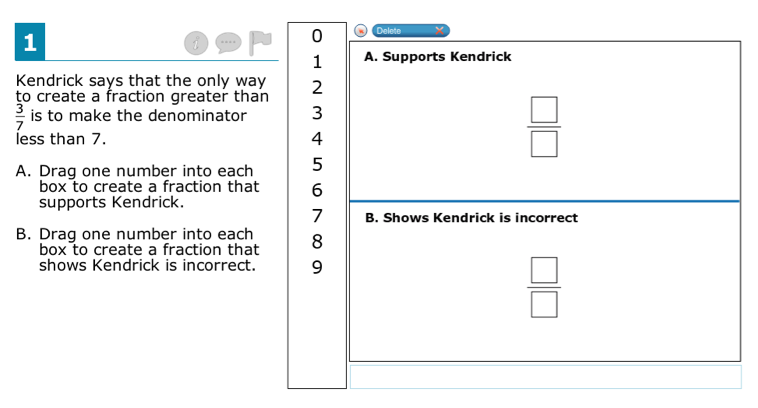
Here is another example for fourth grade as written about on CCSSI Mathematics that should make it clear to the average parent why their child comes home from testing in tears.


“Support/don’t support the conjecture” format questions like this one appear repeatedly in the SBAC sample tests.  Andrew Stadel reviewed a Grade 6 question of this type as part of a nice assessment comparison done in a video format.

Unfortunately, this SBAC question by its wording (and the others, as well) leads students down a mathematically indefensible path.  In mathematics, one does not prove a conjecture by one or numerous consistent examples, but one can disprove a conjecture by a single counterexample.

The weakness of this particular question is found by considering together both the conjecture’s absolute nature (“the only way”) and the wording in part A.  Students can write 3/6 (or many other choices) as the answer to part A, which is greater than 3/7, but it doesn’t “support” Kendrick’s conjecture in the mathematical sense of being one step on the way to completing a proof (described in SMP thusly: “mathematically proficient students...make conjectures and build a logical progression of statements to explore the truth of their conjectures.”  We shouldn’t be forcing fourth grade students to make or support fallacious arguments without understanding the big picture.

The question is simply asking students to “show how it possible to create a fraction greater than 3/7 by making the denominator less than 7.  Also show how it is possible to create a fraction greater than 3/7 where the denominator is NOT less than 7.”  Students are being asked to provide examples and counterexamples, but not prove anything.  It's clunky and additionally confusing because Part B is akin to a double negative... We won't even discuss the random 11 non-consecutive numbers given as possible answers.

So this is the best that standardized test developers can give us to measure the standards they wrote? We can see that the test prep companies, owned typically by the test providing companies, are going to get a lot of business getting kids ready to take these tests.

The Bill & Melinda Gates Foundation and the Pearson Foundation (a non-profit organization owned by the for-profit version of the Pearson company) worked together to create complete online curricula for the new common core standards in math and English language arts for elementary through high school. Both Foundations contributed to the development of the common core standards. This off-the-shelf curricula includes the materials, the teacher preparation, teacher development and, of course, assessments. It is being developed by America's Choice (now owned by Pearson) headed by Phil Daro and Sally Hampton who, coincidentally, were on the original drafting committee for the common core standards. Doesn't that form a nice little package?

Not every state is blind to the problems in the SBAC tests. Alabama, Pennsylvania and Indiana have, or are in the process of dropping out. With each loss of a state, the cost to the remaining states grow. How much is Missouri going to be willing to pay for tests with these kinds of questions? Do we even know what our share is going to be in 2014? Is this even what we were promised in the pretty brochures?


Saturday, February 16, 2013

PTA Receives More Money to Push Common Core Standards


ALEXANDRIA, VA, Feb 15, 2013 (MARKETWIRE via COMTEX) -- National PTA announced today that it received a one-year $240,000 grant from the GE Foundation to further its efforts on the Common Core State Standards. 

National PTA will expand its Common Core work by creating state-specific assessment guides for every state that has adopted the Common Core State Standards. The resource will be a key supplement to National PTA's popular Parent's Guide to Student Success which has been used throughout the nation by community partners, school districts and departments of education.
 "As the largest child advocacy organization in the country, National PTA has played a leading role in educating families and communities about the Common Core State Standards for years, creating a groundswell of support for this historic reform," said Betsy Landers, National PTA President. "The need for creating awareness of the standards remains a high priority. We believe that new resources focused on assessments and accountability systems must be included in the public dialogue to ensure that parents are knowledgeable about the standards and remain supportive during the transition phase in each state." 

 Since parents and taxpayers were largely left out of the Common Core process (as well as legislators), maybe the GE Foundation needs to try and gain support for these standards from the parents of the students who are having to learn what their schools are mandated to teach.  Maybe the PTA wants to do some damage control and explain why parents can't figure out the type of math their children are now learning.  Read more here.

Tuesday, February 5, 2013

PTA Implores Love for the Common Core. Why?

Eric Hargis, Executive Director of the National PTA writes in Don't Politicize the Common Core in edweek.org:


Unfortunately, like so many other issues, the Common Core State Standards are surrounded by myths and are being misrepresented for supposed political gain; the incredible value that the Standards provide to parents wanting to be fully engaged in their children's education makes this all the more dangerous and could represent a huge loss to our education system in America.

Bashing anything done by the Federal Government, always a popular sport in America, has now reached Olympic class status, and there are those claiming that the Standards are a government take-over of education and call them "Common Core National Standards." This isn't even a Pinocchio stretch of the truth, but an out and out lie. The truth is, states are driving this process and have been involved at every level —  from the drafting and development stages through revisions and the final product.

In fact, states voluntarily adopted the Standards. States can even go above the content of the Standards by 15% to cover content that they feel is important but not currently a part of the Standards. Importantly, states and school districts still have autonomy in decisions made on how to teach the Standards in the classroom.

At the same time, as a parent, I will be assured quality and consistency in my children's education regardless of where we live. While most all members of state and district education boards pursue only the highest of academic standards, one need only watch the television talk shows to hear what a few believe should be taught as science and history. Let's keep them on the talk shows and out of our classrooms!

As we all know too well, business in Washington and in many states is driven by partisan politics. Despite the proven effectiveness of the Common Core State Standards, they have become an easy target for a bickering Congress, and divided state and local leaders. The American people are tired of the political games that are hurting our children. We want our government leaders to come together to ensure that our children receive a better education than we did. Those states that have still not adopted the standards for purely political reasons are doing their state's students an incredible disservice. 

Mr. Hargis' contentions need to be addressed:
  • The states are not driving the process of Common Core standards.  It has been documented the standards are privately owned and copyrighted and states/schools/districts cannot alter the standards/assessments.
  • States "voluntarily" adopting the standards statement comes with a caveat.  If states did not adopt the standards, they were ineligible to gain a waiver from the NCLB goals. Describing this as a "voluntary" choice meant states jumped from the frying pan into the fire.  What kind of " voluntary choice" is this really?
  • He is correct that states will be "allowed" to go above the mandated standards/assessments to deliver an extra 15% of material.  Why should there be mandates on schools/districts/states that "allow" teachers to teach a whopping 15% of the "allowed" material?  Is it even feasible to teach additional material when assessments may be scheduled every three weeks on the mandated 85%?
  • Bashing anything done by the Federal Government might just hold important validity.  Federal Spending has skyrockted 190% in four decades and test results have flatlined.  This is not a ringing endorsement of the Federal Government's involvement in education, which is a state's responsibility.  The Federal Government certainly has its hands in the CCSS mandates as it funded the consortia via Stimulus funding.
  • Mr. Hargis is simply making up fact when he states "despite the proven effectiveness of the Common Core State Standards"....these standards are in reality unproven and untested.  They have never been implemented in small studies to determine their effectiveness.  
  • States pushing back on Common Core standards (such as my state, Missouri) are in fact, doing their state a great service by demanding back local control (and cost) of standards and assessments for their students.  Perhaps Mr. Hargis sees it as a political tug of war.  Many of us prefer to see it as the reclamation of state authority to provide educational direction for students and a voice for local districts in the most effective way to educate their community's children.
  • Mr. Hargis writes: "While most all members of state and district education boards pursue only the highest of academic standards, one need only watch the television talk shows to hear what a few believe should be taught as science and history. Let's keep them on the talk shows and out of our classrooms!" Question: Who SHOULD decide what should be taught as science and history?  Should this be assigned to private trade organizations who copyrighted the standards/assessments that states/districts/schools cannot alter and taxpayers cannot change even though tax dollars have paid for them?
Mr. Hargis believes this is a parental involvement issue and will help parents become more involved in educational decisions.  That's an interesting viewpoint.  Parents are discovering objectionable material being taught to their children and the school can only shrug its shoulders and say "sorry".  It's mandated by the Common Core standards.

Why would Mr. Hargis come out with such an article imploring that we all love the Common Core standards when many of his claims cannot be proven or are just flat out wrong?  Could it be that the National PTA accepted a lot of money from CCSS proponents?  From Red Flags, National PTA, and Common Core Standards at susanohanian.org:


Clearly the Gates Foundation has added to this bucket of money by giving the PTA a million dollars to use in promoting the standards.

You can read all about the numerous red flags in the 2009 article.  The author, Niki Hayes, writes:

An immediate red flag appears, for example, because the PTA jumped onto the CCSSI bandwagon in September 2009—before the public input period was completed that ran from mid-September to mid-October. Ideas, questions, and concerns "from the field" of those who would have to live and work with these standards were not considered by the PTA’s leadership before they made this big leap with an incomplete product. 

With all due respect to Mr. Hargis, a million dollar contribution from Mr. Gates does not make the standards any more than what they are: centralized, federally supported/funded, unproven, untested and an incomplete product (3 years in the making) of expensive theories and plans to make education reformers wealthy. Opponents are not "politicizing" the Common Core standards, they are just asking for data to prove their effectiveness and questioning the legality for these private/public partnerships to decide how communities pay for and provide educational services to students.

Wednesday, September 5, 2012

Walk away from School Districts Striving to have "Distinguished" Teachers Under Bill Gates' LEAP Program.

According to Bill Gates' funded assessments,  Denver teachers need to teach social action to become a "distinguished" teacher. 


Walk away from public education in Denver as fast as possible.  Stop the silly talk about how charters, vouchers and education reforms will "save" education.  Find other alternatives for your children.  It's a sinking ship. As long as schools are directed by special interest money for certain agendas, public schools' curricula may have other purposes in mind than just the 3 R's.

Read below and determine if this is a system worth saving.  From utahnsagainstcommoncore: "The 4th 'R' of Education: Rebellion":

Last night, former gubernatorial candidate and talk show host, Morgan Philpot posted online a link to this alarming article from the Daily Caller:

According to NBC affiliate KUSA, Denver Public Schools is implementing a new system to evaluate teachers. In order to achieve a coveted “distinguished” rating, teachers at each grade level must show that they “encourage” students to “challenge and question the dominant culture” and “take social action to change/improve society or work for social justice.”
The new DPS teacher assessment system, called LEAP (Leading Effective Academic Practice), stems from state legislation passed in 2010 and is overwhelmingly funded by a $10M grant from the Bill and Melinda Gates Foundation.
So let me get this straight. The Gates Foundation signs a 2004 agreement with UNESCO to create a global education system, puts $100 million into funding and promoting Common Core, sponsors a conference on eugenics, funds biometric tracking of children, and now they are funding social justice based teacher evaluation systems. Darn, I wish I could find a pattern here that our state leadership could latch onto.
Debbie Hearty, executive director of the Office of Teacher Learning and Leadership at DPS, told KUSA that she wants kids as young as first graders to emulate Martin Luther King, Jr., Mohandas Gandhi, Rosa Parks and others.

“Education that causes action is really important,” Hearty said. “It’s what our kids do with what they learn and apply in the real world.”

John Peterson, a history teacher at Denver’s East High School, was less enthusiastic about the new metric.
“I really don’t think it’s the right place for the school district to expect teachers to push students to become activists,” Peterson said.

KUSA stressed that LEAP is a pilot program subject to change based on input from teachers and others.
“I hope it’s seen by the district as an overreach or an error,” Peterson added.

Pam Benigno, the Director of Education Policy for the Independence Institute, a libertarian-leaning Colorado think tank, said she views the evaluation criteria as an abuse of power.

Younger children could become confused after receiving encouragement from teachers to attack the dominant culture, Benigno suggested. She also wondered how the new criteria would be used to assess algebra and music teachers.

“Half of the kids in DPS aren’t even reading at grade level, yet the school district wants to make them into little social activists,” Benigno said. (MEW emphasized)


Want to know more about LEAP in Denver?  It's amazing what Bill Gates' $10 Million will buy in a school district.  Susan Ohanian wrote an excellent article last year about LEAP and Bill Gates' involvement.  Ask yourself why Bill Gates is spending so much money telling school districts (and it's not just in Denver) how to operate.  From "A Monster Rubric to Define Who's Effective and Who's Not":

NOTE: The Denver Public School System and the teachers' union are partners in a $10 million grant from the Gates Foundation to fund an overhaul of the district's teacher support and evaluation system. Here's how the Denver Post described it:

Denver Public Schools testing system to give teachers in-class evaluations and feedback

By Yesenia Robles
The Denver Post
Posted: 01/30/2011

An effective teacher will ask students to explain their answers whether they are right or wrong. Effective teachers also wait about 3 to 5 seconds for students to respond, but will give more time to students who are English language learners.
Those are part of the specifics outlined in a 28-page rubric that will be used to evaluate teacher effectiveness at Denver Public Schools using a new framework two years in the making. A pilot version of the framework, called Leading Effective Academic Practice, or LEAP, has been sent out for testing in 16 DPS schools this month.
"We have to roll it out to see how it works, but we really hope it will help us identify our highest performers so we can learn from them and spread that knowledge to the lower-performing teachers who need support," said Tracy Dorland, executive director of educator effectiveness for DPS. . . .


Here's the announcement from the Gates Foundation:
Date: January 2010
Purpose: to accelerate the district’s human capital reform by implementing an aligned teacher performance management system based on research findings from the measures of effective teaching project with student achievement and growth at its core

Amount: $10,000,000

Of course, this is peanuts. Elsewhere, Gates spent big bucks to define teachers in its image:
Intensive Partnerships for Effective Teaching sites:


  • Hillsborough County Public Schools (Tampa, Fla.): $100 million


  • Memphis City Schools: $90 million


  • Pittsburgh Public Schools: $40 million


  • The College-Ready Promise (five charter school networks in Los Angeles: Alliance College-Ready Public Schools, Aspire Public Schools, Green Dot Public Schools, Inner City Education Foundation, and Partnerships to Uplift Communities Schools): $60 million


  • Ohmygod, how many pages are in their rubrics? 

    I'll add my own OMG statement.  Dorland has taken a page from the Nancy Pelosi handbook of explaining health care reform and applying it to education reform:

    "We have to roll it out to see how it works, but we really hope it will help us identify our highest performers so we can learn from them and spread that knowledge to the lower-performing teachers who need support," said Tracy Dorland, executive director of educator effectiveness for DPS. . . . 

    Are you ready to take your child out of public school systems supported (or taken over by Bill Gates, take your pick) by LEAP and the Gates Foundation?  Are you tired of these educrats utilizing unproven and untested theories and methods on your children?  I want children to learn in this type of classroom (Ohanian's description) rather than a classroom dictated by assessments and rigidity:

    The education managers who add up the points from official classroom observations can't judge what really counts: Flexibility, the ability to bounce back after 63 defeats, ready to try again. I'm not much interested in seeing how a teacher carefully structures her lesson so that the kids stick to the objectives and the bell always rings in the right place--just after she makes her summary and gives the prelude for what will come tomorrow. I want to find out if that teacher is flexible and tough and clever and loving. I want to be sure she's more nurturing than a halibut.

    What does she do when a kid vomits (all over those neat lesson plans)? Or an indignant parent rushes in denouncing a book? Or the worst troublemaker has a meltdown? Or somebody spots a cockroach under her desk?

    The most wonderful satisfactions of teaching happen in the blink of an eye and are usually unplanned and unexpected. You can miss their importance and lose their sustenance if your eyes are glassily fixed on the objective your lesson plan promises you'll deliver that hour. Our joy is in the daily practice of our craft--and often in those unexpected interruptions. We must talk, not of time on task but of the tantalizing vagueness and the lumps in the throat, the poetry and true purpose of our calling.

    Bill Gates be damned: Keep your eye on the sparrow, not on the Standards.


    Monday, May 7, 2012

    Are Your School Board Members Independent Thinkers or Parrots? Time to Find Out.


    DESE and Local School Board Response to Arne Duncan's Educational Mandates?


    Do your state and local board members understand Common Core standards and the ramifications in the push for privatizing public education?  You might just want to forward these three pieces against the standards and massive privatization to your state and local Board members and compare their responses.  My local district's response so far has been almost identical to the DESE statements from Jefferson City.  

    Do ANY state or local educational bureaucrats responsible for your child's education truly understand the standards or are they just propagating the information paid for by Gates and other companies making billions on "education reform"?

    ****************************************************************


    University of Oregon professor Yong Zhao's 2009 book Catching Up or Leading the Way sent a jolt through our educational system. He questioned the use of tests and "accountability" from the unique perspective of someone educated in China, now living - and raising children - in the USA. His next book, World Class Learners: Educating Creative and Entrepreneurial Students, is due out soon, so I asked him to share some thoughts about some current issues.......

    Question: What will be different five years from now if the current plans go forward?

    Yong Zhao:
    It's always dangerous to predict the future. But if history is any indication, judging from the accomplishment of NCLB and Race-to-the Top, I would say that five years from now, American education will still be said to be broken and obsolete. We will find out that the Common Core Standards, after billions of dollars, millions of hours of teacher time, and numerous PD sessions, alignment task forces, is not the cure to American's education ill. Worse yet, we will likely have most of nation's schools teaching to the common tests aligned with the Common Core. As a result, we will see a further narrowing of the curriculum and educational experiences. Whatever innovative teaching that has not been completely lost in the schools may finally be gone. And then we will have a nation of students, teachers, and schools who are compliant with the Common Core Standards, but we may not have much else left.

    Read the rest of the interview here.

    ************************************************************
    From Ze'ev Wurman in Betrayed:

    Common Core research is "just another piece of misleading advocacy"

    By Ze'ev Wurman

    "What Schmidt is doing here borders on the dishonest."
    - Ze'ev Wurman

    Last week Bill Schmidt, of Michigan State University, rolled out in a highly publicized national press event the “key conclusions” from his recent research. We can’t see any of the underlying research, as Schmidt did not publish it. Its supposed findings, however, already got so much uncritical exposure and praise from the usual suspects that it is important to put Schmidt’s words in their proper context. And that context seems more problematic than organizations like Achieve, or Chiefs for Change, who sponsored this research, would like us to believe. 

    .........Bill Schmidt centers his argument around two themes: that the Common Core standards are similar to those of the A+ countries; and that states with standards more congruent to the A+ countries show bigger progress on the NAEP. To make the last claim work, Schmidt redefines “congruency” to include cut-scores for no logical reason. Both claims are unsupported by his own data and, in addition, his own data is riddled with errors.

    Yet, the
    Chiefs for Change already tout that, “Dr. Schmidt’s research shows that state leaders are on the right track. Common Core State Standards have the potential to raise student learning and performance across America. Most importantly, they are competitive with the standards found in the highest achieving countries.”

    What Dr. Schmidt presented is just another piece of misleading advocacy research, brought to you and paid for by the Bill & Melinda Gates Foundation and channeled through the friendly services of Achieve (which received a recent $375K grant for advocacy from the Gates Foundation), the
    Foundation for Excellence in Education (which received a recent $1M grant for advocacy from the Gates Foundation), CCSSO (which received $9.5M last year from the Gates Foundation to promote the Common Core), and Chiefs for Change (funded by the Foundation for Excellence in Education).

    Read the rest of the article here.

    Ze'ev Wurman worked over 30 years in the high tech industry, most recently as the Chief Software Architect with Monolithic 3D, a semiconductor start-up in the Silicon Valley. He has a long involvement with mathematics standards and assessment in California and served on the 1997 Mathematics Framework Committee and on the STAR Mathematics Assessment Review Panel since its inception in 1998. He was a member of the 2010 California Academic Content Standards Commission that evaluated the suitability of Common Core’s standards for California. He was a member of the Teaching Mathematics Advisory Panel to the California Commission on Teacher Credentialing. Between 2007 and 2009 Wurman served as a Senior Policy Adviser to the Assistant Secretary for Planning, Evaluation, and Policy Development in the U.S. Department of Education. Wurman has B.Sc. and M.Sc. degrees in Electrical Engineering from the Technion, Israel Institute of Technology.

     ****************************************************************

    This is from a writer in The Republic in Columbus, IN alerting readers to the privatization push in education.  This writer focuses solely on conservatives pushing this reform and seems to be blaming them for these measures.  The last time we looked, Michelle Rhee, Arne Duncan, Bill Gates, David Coleman and even the President were not considered conservatives...and yet, they are embracing this increasing privatization:

    A headline on the front page of the Republic on May 1st, read “Officials: Web ISTEP gaffes fixed”. The first sentence was “The Indiana Department of Education said it believes a contractor has fixed the problems that kicked as many as 9,000 students offline during computerized ISTEP tests last year.”

    I know, that doesn’t sound all that captivating but hang on — there may be more to this than you think.

    The article cited was about the test problems and hoped for solutions created by CTB/McGraw-Hill. Now, everyone who went to public school in this country must have heard of McGraw-Hill. They published all sorts of text books with emphasis on science and technology. But what’s this CTB stuff? CTB has developed as a result of NCLB.

    Are you still there? NCLB is No Child Left Behind. CTB is part of McGraw-Hill that does the tests and assessments required by NCLB and makes huge profits in the process. Where do they get the money for these huge profits?

    From you and me.

    Bet I have your attention now.

    One of NCLB’s unintended consequences was to change the standardized testing industry from a 5 billion dollar a year business to a 15 billion dollar a year industry. Where did that extra 10 billion dollars come from? From the states’ department of education and school boards. In other words, our tax dollars. The states’ books might look better, but less of our money is going to the public education of our children.

    ....Indiana has a few problems with the privatized testing services. That’s not the real issue, people.

    Governor Daniels’ talking points on education follow the mission statement of the Foundation for Excellence in Education, a group headed by Jeb Bush, who claims to be a “limited government conservative”. His group promotes private school vouchers, online courses, reading tests etc. All non-public.

    You can start referring to this as the industrial-education complex.

    Read the rest here. 

    *******************************************************************

    Forward these articles to your state and local officials.  Ask them what they think about this massive private intrusion and direction of public education that taxpayers are beholden to pay for....that many writers, educational professionals and citizens increasingly have come to believe are doomed to fail.  

    Determine if you are getting the parroted answer from DESE statements, or even better yet, from the Department of Education.  You want to bet a box of crackers what your officials will say?


    Friday, July 22, 2011

    Didn't They Tell Us Common Core Standards Wouldn't Create a Common Curriculum? Is This a Shell Game?


    Common Core standards have been adopted by more than 40 states. While it has been heralded as voluntary, Title I funding was threatened to be withheld if states did not sign onto the standards. Critics of the standards have been vocal about the adoption process and the standards themselves. Here are some issues about the standards from Truth in American Education:

    The CCSS Mathematics Standards:

    • Delay development of some key concepts and skills.
    • Include significant mathematical sophistication written at a level beyond understanding of most parents, students, administrators, decision makers and many teachers.
    • Lack coherence and clarity to be consistently interpreted by students, parents, teachers, administrators, curriculum developers, textbook developers/publishers, and assessment developers. Will this lead to consistent expectations and equity?
    • Have standards inappropriately placed, including delayed requirement for standard algorithms, which will hinder student success and waste valuable instructional time.
    • Treat important topics unevenly. This will result in inefficient use of instructional and practice time.
    • Are not well organized at the high school level. Some important topics are insufficiently covered. The standards are not divided into defined courses.
    • Place emphasis on Standards for Mathematical Practice which supports a constructivist approach. This approach is typical of “reform” math programs to which many parents across the country object.
    • Publishers of reform programs are aligning them with the CCSS Standards for Mathematical Practice. The CCSS will not necessarily improve the math programs being used in many schools.
    • Unusual and unproven approach to geometry.

    The Standards for English Language Arts and Literacy in History/Social Studies, Science, and Technical Subjects (ELA):

    • Use confusing language in some standards.
    • Are not always clear or measureable on expected student outcomes.
    • Are not always organized in a logical way and are difficult to follow.
    • Treat literary elements inconsistently.
    • Have some writing standards that are general and do not specify what a student should be able to know or do.
    • Focus on skills over content in reading.
    • Do not address or require cursive writing.
    Truth in American Education also points out these concerns about the standards:

    The move towards Common Core State Standards and the two consortia developing assessments have led some to advocate for a common core or national curriculum, as called for by the Albert Shanker Institute in A Call for Common Content: Core Curriculum Must Build A Bridge From Standards to Achievement. A national curriculum would further erode local control and raises other serious issues as indicated in Closing the Door on Innovation: Why One National Curriculum is Bad for America. This response includes the following concerns:
    1. No constitutional or statutory basis for national standards, national assessments, or national curricula.
    2. No consistent evidence indicates that a national curriculum leads to high academic achievement.
    3. Developed national standards are inadequate for basing a national curriculum as planned by the administration.
    4. No body of evidence recommends a “best” design for curriculum sequences in any subject.
    5. No body of evidence justifies a single high school curriculum for all students.

    So why the rush to adopt unproven and unfunded standards? As one of the main sponsors and financial supporters of the Common Core standards (who also will benefit financially from this educational arrangement), this statement comes from the Bill and Melinda Gates Foundation as noted by EdWeek:

    The Gates Foundation expressly admits that its intention is to align learning tools with the Common Core State Standards and “to fundamentally change the way students and teachers interact in the classroom, and ultimately, how education works in America.”

    Why should the Gates Foundation determine the educational direction of ALL American students? Why is the DOE and Arne Duncan cozying up with the Gates Foundation allowing a private company to dictate education services? Why should the Gates Foundation and other private organizations such as the National Governor's Association (NGA) and CCSSO (Chief Council of State School Officers) direct the standards for American students?

    Administrators and teachers are beginning to ask these type of questions:

    New guidelines on crafting curriculum materials for the common standards in English/language arts are reigniting debate about how to ensure a marketplace of good instructional materials for the new standards without crossing the line into telling teachers how to teach.


    The two publishers’ criteria documents, totaling 24 pages, land in a swirl of discussion about how to create good curricula for the common-core standards, which emerged from an initiative led by the nation’s governors and state schools chiefs. One central tension in the discussion has been trying to address the need for instructional tools without dictating pedagogy; another has been the question of who should shape curriculum design.

    Why should you, as a taxpayer who may have a child in the public school system, be concerned about pedagogy or curriculum design? Here is a statement of "philanthropic" intent from the Gates Foundation:

    The Gates Foundation, for instance, has convened conversations that included representatives from other sectors, among them the environmental-protection and food industries, to talk about how their certification processes might inform parallel work in the curriculum world.

    Jamie McKee, who helps lead common-standards work for the Seattle-based Gates Foundation, said that while the foundation “cares deeply about the quality of the [instructional] materials that come from the common core,” it hasn’t yet decided whether it favors a panel or process for validating such materials.

    The foundation continues to listen to a range of views about “what comes next for the standards, and how to find the right balance” between helping the field produce a range of sound instructional materials and wading into judgments about products, she said.

    Think about it. You now have common core standards directing the teaching of whatever social issue the Gates Foundation thinks important! The Foundation wants to "align learning tools with the common core curriculum". What control and what power over student learning certain crony capitalists possess.

    Concern also arises about how and what teachers can teach:

    “The very people writing [the standards] are the ones telling everyone else how you’re supposed to comply,” said Walt Chappell, a member of the Kansas state board of education. “What we have is a group of people dictating to everyone else what’s to be taught in every classroom, to every student.”

    Can the designers of the common core standards continue the shell game routine and keep pretending they can set standards for the majority of American students without telling teachers how to teach? Maybe even the Gates Foundation can't pull off this sham much longer. Just remember their goal: it's looking into combining standards into curriculum it deems important. Tell us again how you can combine standards and curriculum and insist you're not telling teachers how/what to teach?

    And again, we ask: why does a private organization have such power to make public policy?


    Site Meter