
Lofty words, yes, but almost the sense you get from reading the propaganda about Common Core. These magical standards are going to guarantee that every child will be ready for college and career. CCSSI and SBAC were careful not to actually state that guarantee. In fact, they supplied a disclaimer on their products warning you that they were not responsible for any educational failures that result from using their standards.
-->
"Under no circumstances shall NGA Center or CCSSO, individually or jointly, be liable for any direct, indirect, incidental, special, exemplary, consequential, or punitive damages however caused and on any legal theory of liability, whether for contract, tort, strict liability, or a combination thereof (including negligence or otherwise) arising in any way out of the use of the common core state standards, even if advised of the possibility of such risk and potential damage. Without limiting the foregoing, licensee waives the right to seek legal redress against, and releases from all liability and covenants not to sue, NGA Center and CCSSO."
Regardless, the college and career readiness "implication" is all over their marketing and one of the key reasons groups like the US Chamber of Commerce support common core. Businesses, frustrated with the product government controlled public education has been producing in the last 25 years, want a better product and someone seems to be promising that. They appear willing to overlook the fact that it is the same supplier producing the product while using a different set of production specifications that produced the product they have not been happy with up until now. No one has bothered to look at the assembly line itself to see if there is something in its construction that has been causing the poor product quality. No one has looked at the suppliers of the raw materials to see if the final product inconsistency might be affected by the input materials. They are a victim of their own belief in marketing.
Most critically, few have looked into who wrote the new specifications manual. Those who follow common core know who those writers are and have therefore had reasonable skepticism about the quality of the standards. There were fourteen members on the original ELA drafting committee for common core. (Sorry DESE, but you were not part of the drafting team. You were only allowed to comment on the written standards and, much as you only reluctantly responded to questions given you on May 2nd without any real dialogue or intent to change anything, CCSSI had no real intention of taking your input to their drafted standards too seriously either.)
From the Savannah Morning News,
"Of the 14 members of the Common Core English/Language Arts Standards writing committee, seven worked for ACT or SAT, two of the biggest test makers in America.You should read the whole article. The nepotism at work in the testing and test prep family of businesses feeding off of common core is mind boggling.
Three members work for Achieve, another non-profit organization that helps states — guess what? — form assessments for standards, and happens to be the creator of the American Diploma Project Network.
See how nicely this dovetails with ACT and SAT? Another standards writer, David Coleman, formed the Grow Network, which he sold to—there they are again–McGraw-Hill.
I am usually not a conspiracy theorist. But my scorecard shows 11 members of the English/Language Arts Standards writing team had ties to companies with a financial interest in the committee’s decision." [None were high school or college English teachers.]
But lets just assume for a moment that you are ok with test writers developing standards. At least the standardized tests they give us to measure whether our kids are meeting those standards will be good. Right?
A couple months ago CCSSI proudly released their test practice exam for public review. To say that the reviewers were underwhelmed is an understatement. On the blog mathmistakes, they take on an 8th grade question about probability. Probability is something 8th graders should be able to do and probably could do, if asked the question in a normal way. But the developers of the SBAC test seem so enamored with drag and drop and fancy graphics that the question gets muddied. Worse, if you actually analyze the skills needed to solve their question, ones taught in 7th grade, you would have to develop a tree diagram with 210 lines to answer half the question. (It's a timed test.) The good news is there is an easier way to solve the problem. The bad news is that that standard is not taught until high school. Too bad for the kids sitting at the testing computer in 8th grade.
Here is another example for fourth grade as written about on CCSSI Mathematics that should make it clear to the average parent why their child comes home from testing in tears.
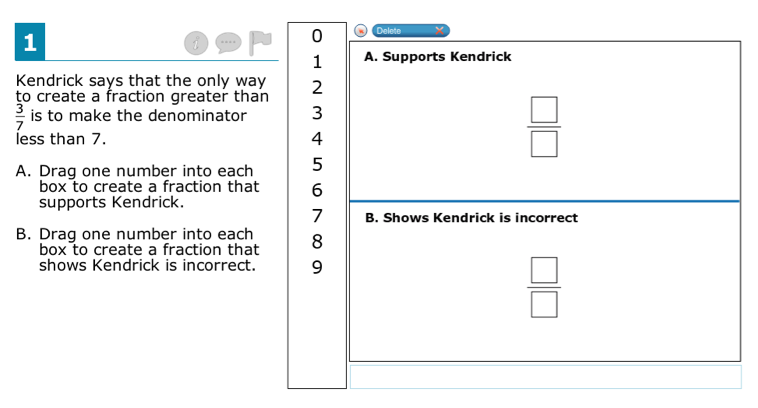
“Support/don’t support the conjecture” format questions like this one appear repeatedly in the SBAC sample tests. Andrew Stadel reviewed a Grade 6 question of this type as part of a nice assessment comparison done in a video format.
Unfortunately, this SBAC question by its wording (and the others, as well) leads students down a mathematically indefensible path. In mathematics, one does not prove a conjecture by one or numerous consistent examples, but one can disprove a conjecture by a single counterexample.
The weakness of this particular question is found by considering together both the conjecture’s absolute nature (“the only way”) and the wording in part A. Students can write 3/6 (or many other choices) as the answer to part A, which is greater than 3/7, but it doesn’t “support” Kendrick’s conjecture in the mathematical sense of being one step on the way to completing a proof (described in SMP thusly: “mathematically proficient students...make conjectures and build a logical progression of statements to explore the truth of their conjectures.” We shouldn’t be forcing fourth grade students to make or support fallacious arguments without understanding the big picture.
The question is simply asking students to “show how it possible to create a fraction greater than 3/7 by making the denominator less than 7. Also show how it is possible to create a fraction greater than 3/7 where the denominator is NOT less than 7.” Students are being asked to provide examples and counterexamples, but not prove anything. It's clunky and additionally confusing because Part B is akin to a double negative... We won't even discuss the random 11 non-consecutive numbers given as possible answers.
So this is the best that standardized test developers can give us to measure the standards they wrote? We can see that the test prep companies, owned typically by the test providing companies, are going to get a lot of business getting kids ready to take these tests.
The Bill & Melinda Gates Foundation and the Pearson Foundation (a non-profit organization owned by the for-profit version of the Pearson company) worked together to create complete online curricula for the new common core standards in math and English language arts for elementary through high school. Both Foundations contributed to the development of the common core standards. This off-the-shelf curricula includes the materials, the teacher preparation, teacher development and, of course, assessments. It is being developed by America's Choice (now owned by Pearson) headed by Phil Daro and Sally Hampton who, coincidentally, were on the original drafting committee for the common core standards. Doesn't that form a nice little package?
Not every state is blind to the problems in the SBAC tests. Alabama, Pennsylvania and Indiana have, or are in the process of dropping out. With each loss of a state, the cost to the remaining states grow. How much is Missouri going to be willing to pay for tests with these kinds of questions? Do we even know what our share is going to be in 2014? Is this even what we were promised in the pretty brochures?


